




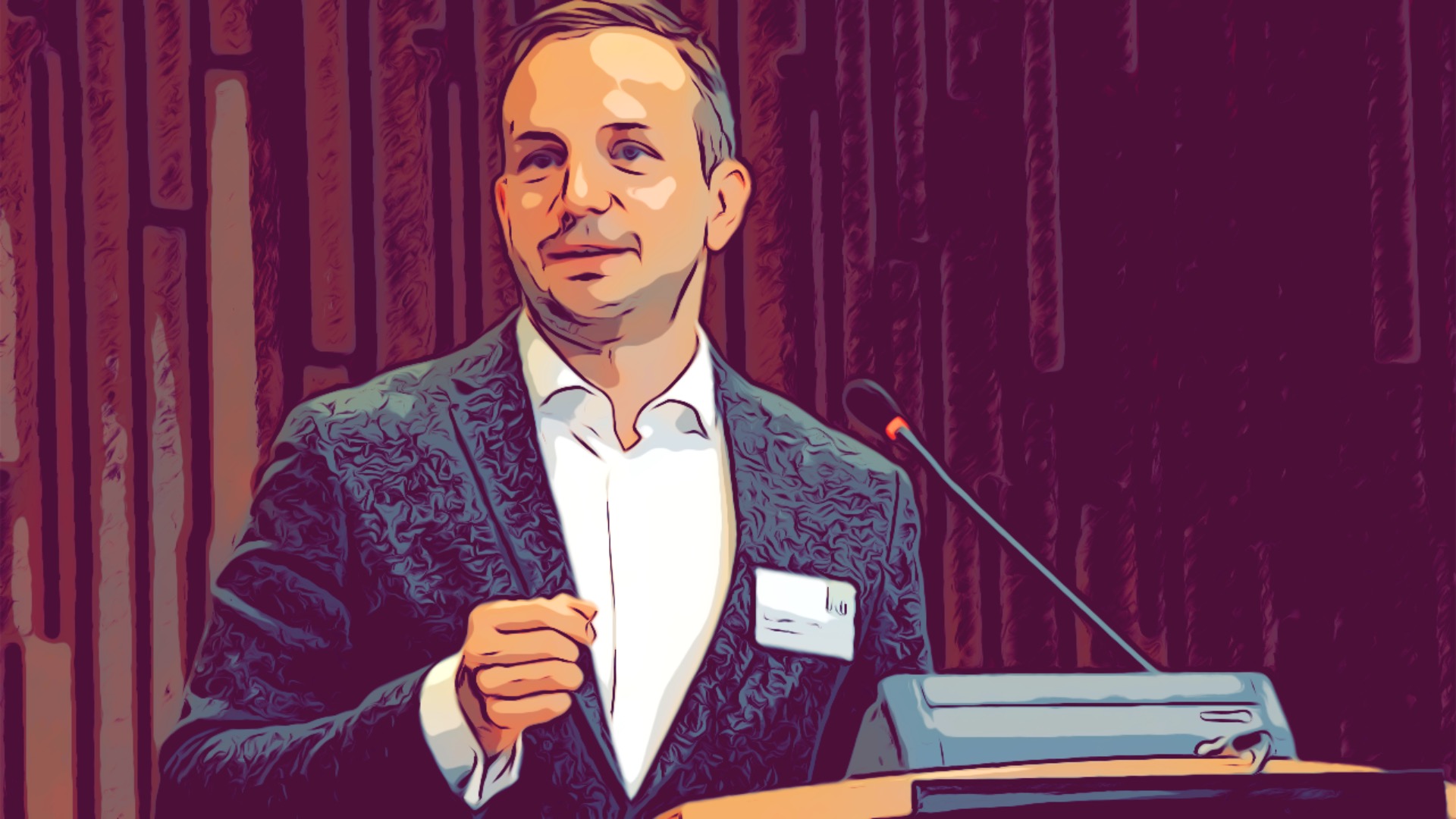

I am an expert in organizational psychology, consultant and professor working at the intersection of AI, healthy high performance and evidence-based management. Over the past years I have advised federal authorities and industrial companies, designed and evaluated leadership and transformation programs, and taught at universities in Europe and China. This international background, together with my cross-cultural competence and experience, has strengthened my sensitivity, open-mindedness and ability to look at organizations from a broad, global perspective. It is this combination of scientific rigor, practical experience and international outlook that underpins the three areas of my work outlined below.
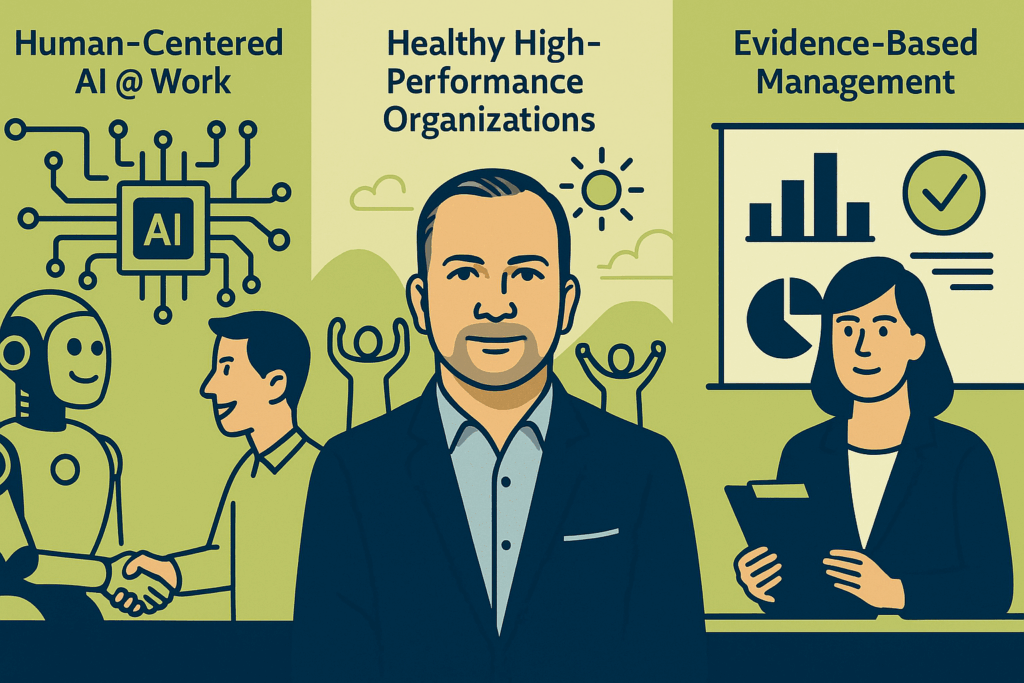
Human-Centered AI @ Work
Designing psychologically sound human–AI collaboration that improves decisions and work – not just technology.
Human–AI interaction is quickly becoming a core competence for modern organizations. The key question is not if AI is used, but how people, teams and leaders work with AI in a competent, responsible and healthy way.
Drawing on my background in organizational psychology and current research on AI use, acceptance and psychosocial impact, I help organizations deliberately shape the interfaces between humans and AI systems.
Focus areas:
- Building AI literacy and critical competence for knowledge workers and leaders
- AI-augmented leadership: using AI to support, not replace, professional judgement
- Leveraging AI to enhance collaboration, communication and knowledge work
- Identifying and managing psychological risks (overload, distrust, loss of control, devaluation of expertise)
- Developing principles, governance and communication for responsible AI adoption
Thus, I am currently developing a Digital & AI Risk and Readiness Index (D-AIR²) which shall support organisation in implementing digital transformation and AI adoption in a responsible, human-centered, and evidence-based manner.
The outcome: AI that strengthens decision quality and collaboration – while people keep orientation, trust and ownership.
Healthy High-Performance Organizations
Creating structures, cultures and leadership systems where people can deliver sustainable high performance.
High performance and healthy working conditions are not opposites; they are the result of coherent organizational design. When structures, roles, processes and leadership styles ignore how people actually function psychologically, performance, engagement and reliability suffer.
Based on evidence from work and organizational psychology and extensive project experience with federal authorities, critical infrastructures and industrial clients, I support organizations in designing environments where people can work with clarity, responsibility and resilience.
Focus areas:
- Designing leadership and collaboration architectures that support clarity, trust and accountability
- Developing healthy leadership programs for senior and middle management
- Strengthening learning, error and safety cultures in high-responsibility settings
- Supporting transformations, reorganizations and system implementations (including AI) with psychological safeguards
- Integrating health, risk and performance perspectives into a consistent operating model
The outcome: robust organizations that enable high professional standards without burning people out.
Evidence-Based Management
Helping leaders take decisions grounded in evidence – not fashion, anecdotes or internal myths.
Too many management decisions are driven by habits, buzzwords or the loudest voices in the room. Evidence-Based Management offers a disciplined alternative: combining the best available research, internal data, professional expertise and stakeholder perspectives to make transparent, robust and testable decisions.
With my background in research, quantitative methods and evidence-based management education, I work with leadership teams to embed this mindset and methodology into their daily practice.
Focus areas:
- Introducing evidence-based management principles into leadership, HR and project governance
- Designing decision frameworks and criteria for strategies, programs and change initiatives
- Using organizational data and research findings to inform high-stakes decisions
- Designing and evaluating leadership and organizational development programs with measurable impact
- Building critical thinking and methodological competence (data literacy, rigorous use of evidence) among executives
The outcome: management that treats decisions as a professional craft – transparent, learning-oriented and accountable.